
DEI Isn't Back. It Never Left. Here's What Did.
The headlines keep changing. Diversity, equity, and inclusion is dead. Then DEI is back. But both declarations miss something important: the knowledge, the practice, and the larger commitment to equity and justice never disappeared. People committed to this work have continued doing it, often under extraordinary pressure.
What fell apart was the promise of performative DEI: the idea that an organization could claim the language of justice without changing the conditions people experience.
And even that requires a qualification. The backlash did not neatly remove empty gestures while leaving meaningful work intact. It damaged both. Real people lost jobs. Skilled teams lost resources. Employees lost people who helped them navigate harm.
For a small business or small nonprofit, the most useful question is not whether DEI is fashionable again. It is this: What changes for your people when equity becomes part of how work gets done?
Can employees access opportunities without private connections? Do complaints receive a fair response? Does the person responsible for improving workplace equity have time, support, and authority?
I care far less about what you call the work than whether you are doing it. Words matter. Action is what changes people's lives.
What Performative DEI Got Wrong
Through All Aces, I have had the privilege of partnering with more than 200 clients across the country. One pattern has been painfully consistent: some organizations became more attached to describing their commitments than to making the changes those commitments required.
DEI became an opportunity for applause, attention, and feeling good about the organization. Meanwhile, employees and communities were still waiting for a different experience.
A 2024 study of DEI leaders at U.S. academic health centers captured a similar problem. One participant reflected on relying on feel-good moments that brought people together temporarily but did not produce lasting change.
That is the temptation of the easy button:
Can we just hold a workshop?
Can we just change a policy?
Can we just publish a stronger statement?
Those activities can contribute to progress. But not in isolation. A workshop does not substitute for an organizational strategy. A policy does not implement itself. A statement does not make an unanswered complaint disappear.
For a small organization with limited capacity, a standalone activity can feel manageable while structural change feels overwhelming. I understand that. But manageable is not the same as meaningful. The question is whether the activity connects to a specific barrier, a person authorized to address it, and a process for checking what changed.
I have also seen approaches that tore teams apart, attacked people, and left those who were supposed to benefit worse off. Activity is not automatically progress. Strong language is not automatically skill. This work requires expertise, care, and a long-term commitment to changing how the organization functions.
The Losses Are Real, and the Need Did Not Disappear
We have to be careful not to describe the backlash as a useful correction that only removed superficial work. People built meaningful equity efforts with skill, love, and years of persistence. Those efforts were damaged too.
A Revelio Labs analysis for NPR estimated that U.S. employers eliminated more than 2,600 jobs with diversity or DEI in the title between early 2023 and spring 2025.
Those losses happened while employees continued reporting discrimination. In fiscal year 2024, the Equal Employment Opportunity Commission received 88,531 new discrimination charges, an increase of 9.2 percent over the previous year. Race discrimination charges rose from roughly 27,500 to about 30,300.
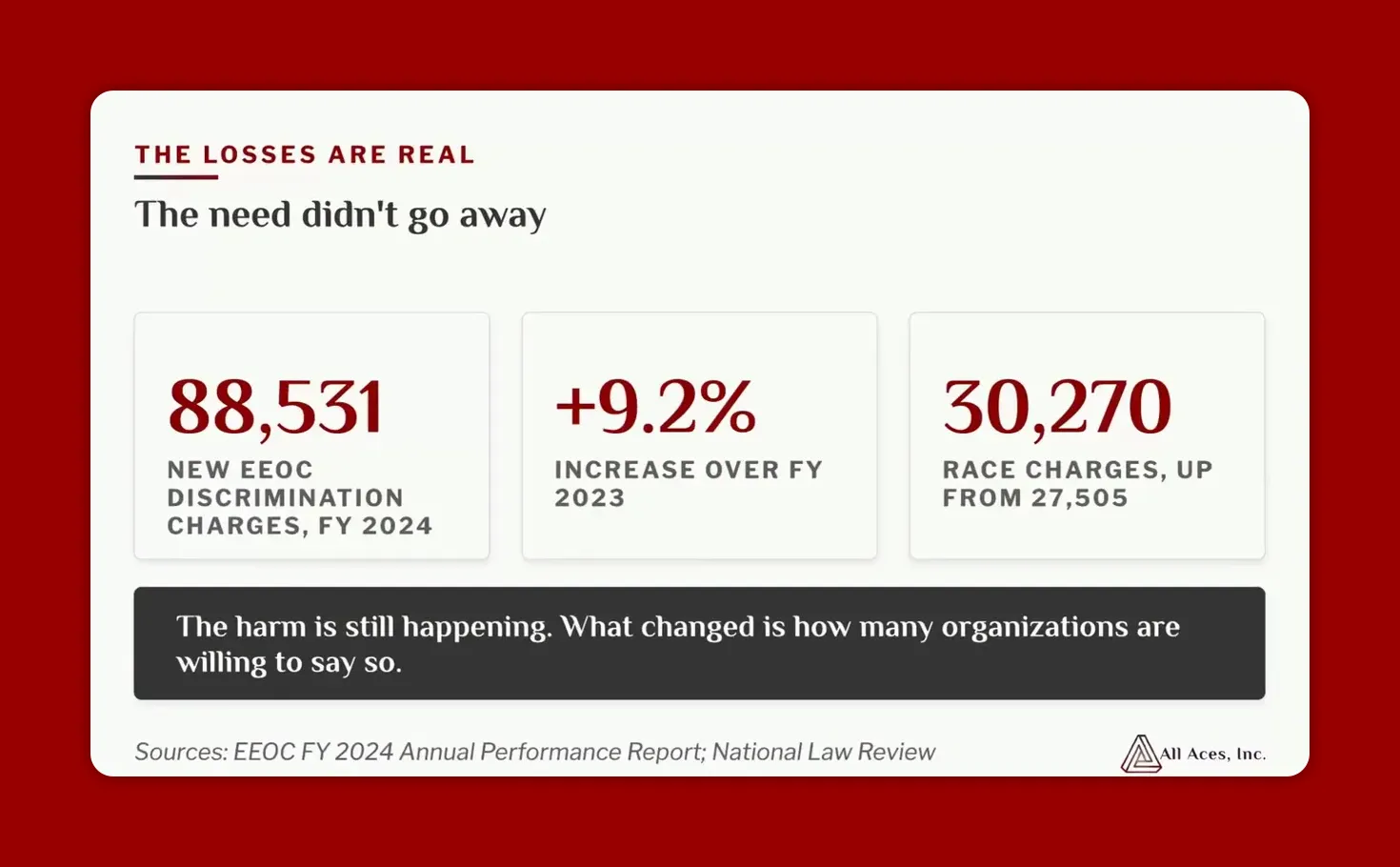
These are charges received, not a count of adjudicated findings. They nevertheless make it difficult to argue that the need for effective internal responses simply went away.
What changed was how willing some organizations were to acknowledge harm, take responsibility, and maintain the structures needed to address it.
A small business or nonprofit may never have had a dedicated DEI position. That does not remove the underlying responsibilities. Someone still decides how pay is set, who receives support, how opportunities are distributed, and what happens when someone reports harm. Those decisions continue whether or not an equity role exists.
If you have been carrying this work, I see you
Practitioners describe being expected to absorb everyone else's pain while having little room to address their own. They are then blamed for failing to repair, as one person, conditions an entire institution created.
In a small organization, that responsibility may sit with someone who already has another full-time role. A call to keep going, stay strong, and do more can become another demand on someone already at the edge.
Collective action requires collective care. People need spaces to collaborate, support one another, and think intentionally about how to continue. Care is not separate from effective equity work. It is part of making the work sustainable.
Your Circle of Influence Still Matters
Resistance to expanding access and shifting power has a history. During the civil rights movement, changes in law did not eliminate the need to fight for enforcement or challenge exclusion within institutions. Martin Luther King Jr. named the white backlash directly.
Predictable does not mean inevitable. What people organize around, what leaders defend, and what organizations fund all shape how much ground is lost.
Elections matter, but they do not settle the work inside your organization. An election may change who writes laws. It does not automatically change your promotion process on Monday morning. Executive orders, enforcement priorities, and court rulings also remain consequential until they are changed.
We can influence national conditions, but we do not individually control them. We do have influence over the organizations we lead, work in, govern, and support. Stephen Covey's concept of a circle of influence is useful here.
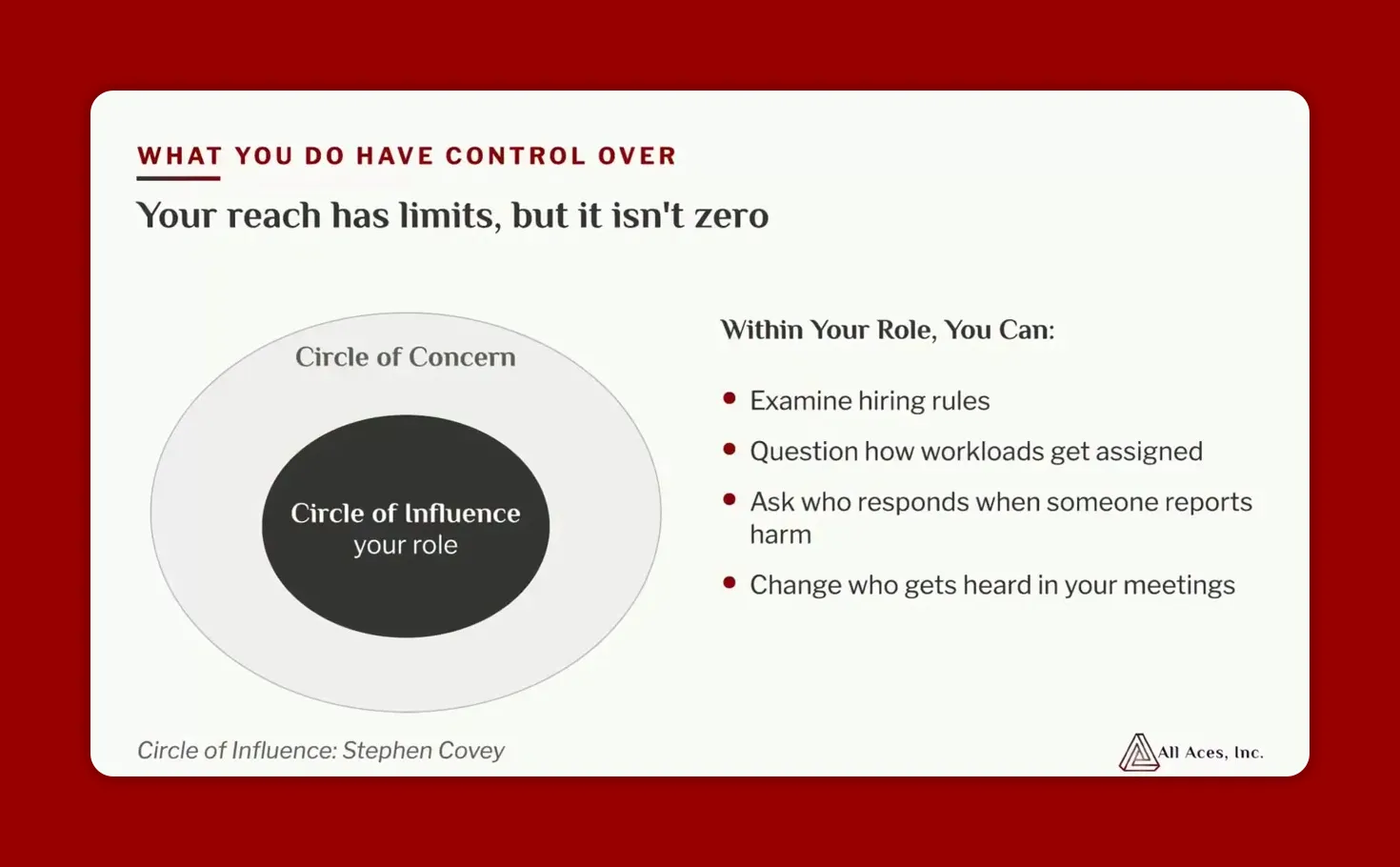
Within your own role, ask:
How are hiring requirements established and applied?
Who decides how workloads are assigned?
Who gets heard in meetings?
Who receives support when work becomes difficult?
Who responds to a complaint, and how do they respond?
Can someone question a decision without being dismissed?
For a small-business owner or nonprofit executive director, these questions connect equity directly to operating decisions. For a manager, employee, or board member, they help identify where you can raise concerns or change a practice within your authority.
You do not have to control everything to influence something important. But you do have to look beyond the public debate and examine the choices being made around you.
Accountability Without Humiliation
Some approaches to workplace equity centered personal blame and humiliation rather than helping people understand their responsibility and change the conditions around them. We should not reproduce oppressive behavior in the name of fighting oppression.
That observation does not justify attacks on equity. The backlash is about power and reaches far beyond any individual training. It does require us to examine how we pursue change.
Paulo Freire's Pedagogy of the Oppressed connects the pursuit of full humanity with fellowship and solidarity. People do this work together. That leaves plenty of room for firm accountability.
A leader who causes harm needs:
Clear expectations about what must change.
Support to build the understanding and ability to change.
Consequences when harmful behavior continues.
People affected by the harm need protection and a meaningful voice in repair. They should not have to become the leader's educator or carry responsibility for changing the entire organization.
This matters in small teams, where working relationships can be close and authority can be concentrated. Familiarity does not cancel accountability. Nor does accountability require public humiliation.
When harm repeats, look beyond the individual. What allows the behavior to continue? What happens when someone reports it? Does the organization protect the person with authority while expecting everyone else to adapt?
The Integrated Resilience Framework calls for authority with accountability. A person's ability to make consequential decisions must come with responsibility for the effects of those decisions.
Recognize the Values-to-Action Gap
A public statement is not inherently the problem. It establishes what employees and communities should be able to expect. The problem emerges when the organization's practices cannot deliver on that promise.
You say people can grow, but advancement criteria remain unclear. You say people have a voice, but complaints sit unanswered. You celebrate an equity committee, but give its members neither paid time nor authority.
At All Aces, we call the distance between stated values and lived experience the Values-to-Action Gap.
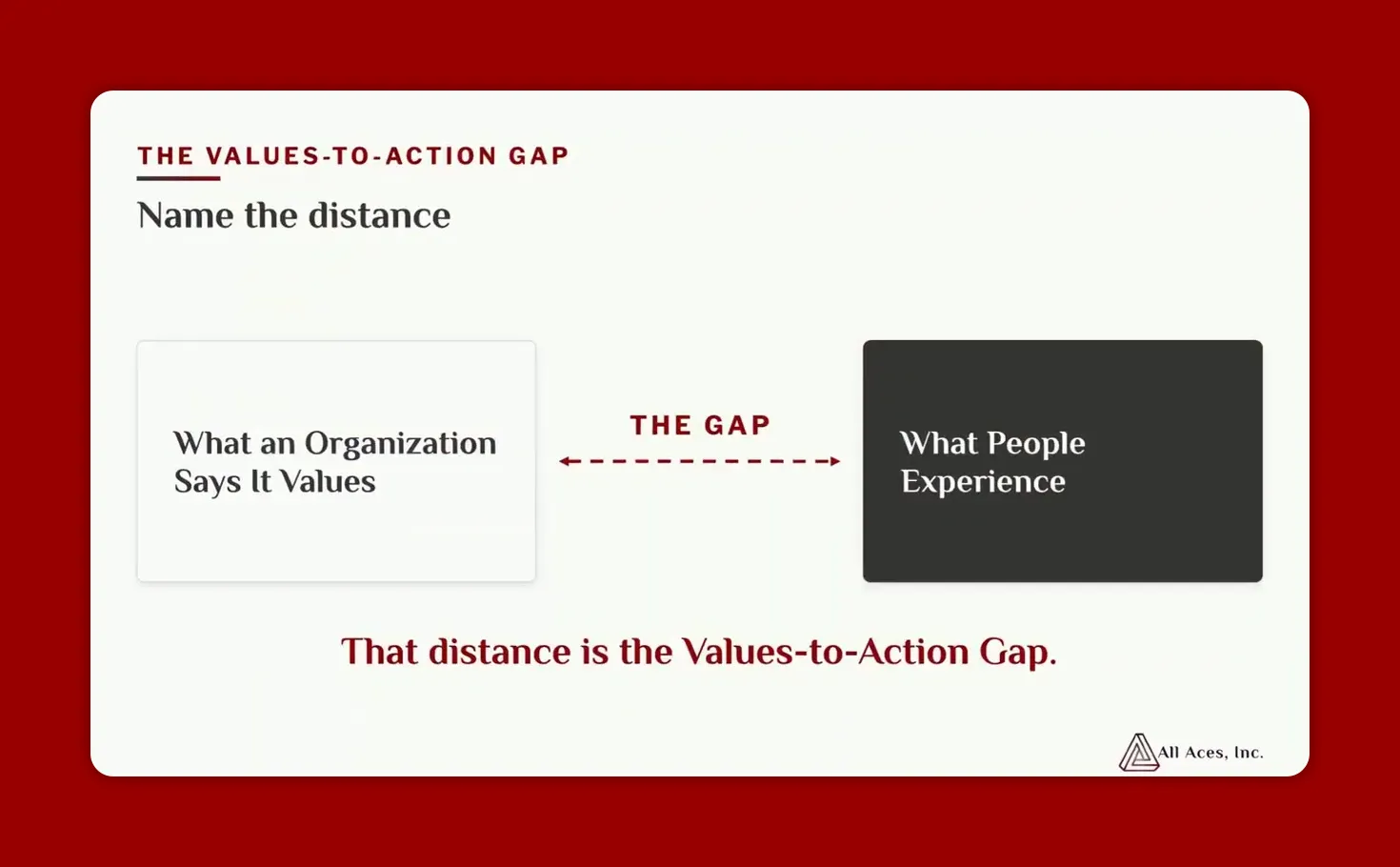
Small businesses and small nonprofits are not exempt because their teams are close or their missions are admirable. Good intentions do not establish that barriers are absent. A mission focused on helping a community does not tell us, by itself, how employees experience the workplace.
Another important distinction is accountability without authority. That happens when someone is responsible for achieving an outcome but cannot change the conditions that determine it.
An employee asked to lead equity work cannot independently resolve every manager's behavior, rewrite every process, or allocate resources they do not control. Calling them a champion does not solve that mismatch.
The 2024 study of 32 DEI leaders published in JAMA Network Open reinforced the importance of resources and authority. Institutions expecting progress must give the people leading the work the means to make change happen.
For a small organization, the practical question is not necessarily whether you need another committee. It is whether responsibility, decision-making authority, paid time, and support are connected.
People need evidence, not another promise
In an April 2026 YouGov survey, a quarter of Americans said they had become more supportive of DEI over the previous decade. At the same time, questions about the approaches organizations take deserve serious consideration.
Too much work has been performative. People are right to ask what it accomplishes.
The response is not a more polished explanation of your intentions. It is change people can recognize: a clearer path to an opportunity, a fairer response, a barrier that no longer determines their experience.
A Promotion Problem Makes the Gap Concrete
Consider a hypothetical employee who wants to move into management. They meet the posted requirements and consistently hear that their work is strong. Yet every promotion goes to someone else.
When they ask what they need to improve, their manager says they need leadership experience.
But which experience counts? How do employees gain it? Who decides who gets the assignments that demonstrate readiness?
No one has explained that part.
The employee needs experience to advance, but access to that experience depends on private conversations and the manager's comfort with people they already know. The path exists for those with the relationships to navigate it. For others, it is effectively invisible.
That dysfunction disproportionately affects Black, Indigenous, and other people of color. It also creates pain and obstacles across the organization. People are trying to do good work while navigating rules they cannot see.
Another message about belonging does not address this employee's problem. They need to know whether they can build a career without guessing which unwritten requirement will appear next.
Make the pathway visible
A practical response has four connected parts:
Write down the requirements. Define what the role actually requires instead of relying on a vague impression of leadership.
Explain the development pathway. Identify how staff can gain the relevant experience.
Open access to assignments. Use a clear process rather than relying on private invitations and existing relationships.
Review consistency. Check whether managers apply the criteria in the same way.
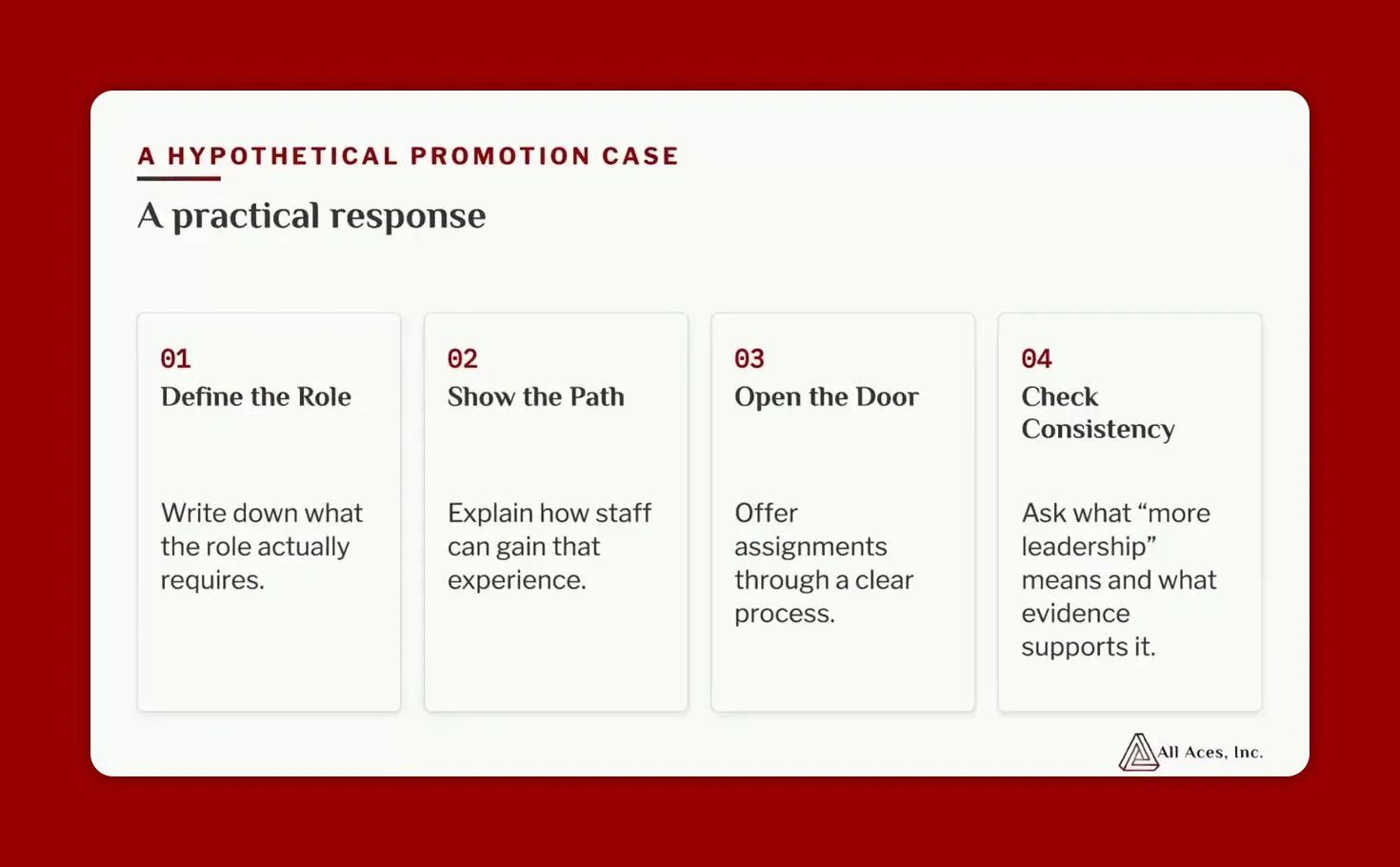
If a manager says one candidate demonstrates more leadership, someone needs to ask what that means. What evidence supports the assessment? Did other candidates have a fair chance to demonstrate the same abilities?
This example matters even in an organization with few management openings. Examine the assignments that build experience, not only the final promotion decision. Ask who learns about an opportunity, who can participate during paid hours, and whose request gets stalled.
You are not adding structure for its own sake. You are making consequential decisions understandable and open to review.
Legal Scrutiny Is a Reason to Do Structural Work Well
In 2025, the Supreme Court ruled unanimously in Ames v. Ohio Department of Youth Services that majority-group plaintiffs do not face an additional background-circumstances requirement when bringing the discrimination claims at issue. The same evidentiary standard applies regardless of group membership.
Some organizations interpret increased scrutiny as a reason to abandon equity and justice work. But the structural work in our promotion example points in a different direction:
Open access to opportunities.
Clear, job-related criteria.
Consistent decision-making.
A record of why decisions were made.
Those practices support fair treatment for everyone, including people disproportionately affected by racism and other forms of oppression.
This is not legal advice. Talk with your own counsel about your organization's specific practices, obligations, and circumstances. A general discussion cannot replace that review.
The larger point is that the structures needed for a well-functioning, resilient organization are also foundational to racial and social justice. Clear processes do not replace justice. They help make commitments actionable and decisions examinable.
Renaming the Work Does Not Change the Work
Organizations have adopted different labels. Citigroup renamed its DEI team talent management and engagement. Disney replaced its diversity and inclusion performance factor with talent strategy. Universities have moved toward language such as belonging, community, and student success.
A small organization may also reconsider its language. But a new label does not answer the employee's question about advancement.
If the same manager still controls the same assignments through the same unwritten rules, the barrier remains. If renaming comes with cuts to staffing, funding, and authority, that is not simply adapting the language to sustain the work. It is retreating from the commitment.
And changing the name back later, without changing a practice, is still performance.
The Integrated Resilience Framework connects desired outcomes, such as fair access to growth and a meaningful voice at work, to how an organization operates across purpose, people, process, and justice, all enabled by capabilities.
For a small business or nonprofit, that means equity belongs in the way work happens, not in a separate promise that everyday decisions can ignore.
Resilience means developing the capacity to address harm, support the people involved, and keep learning as conditions change. It is shared resilience, not extractive resilience.
An organization is not meaningfully resilient if its apparent strength depends on repeatedly exhausting the same employees, vendors, or communities. Build something that can hold under pressure, including a crisis or a change in leadership, without requiring a few people to absorb all the damage.
Start With One Practice You Can Change
You do not need to solve every organizational problem at once. You do need to connect your commitment to a real experience and follow through.
Begin with a difficult question: Where might our organization be contributing to dysfunction and injustice?
Stay with it long enough to identify something concrete. Do not let the belief that your team means well close the inquiry before it begins.
1. Find the barrier in an actual experience
Use the promotion example as a guide. Who hears about assignments before they are filled? Who can take them on within paid hours? Where do requests stall?
The goal is to move from a broad aspiration, such as fairness, to the point where a person encounters an obstacle. That gives your team something specific to investigate and change.
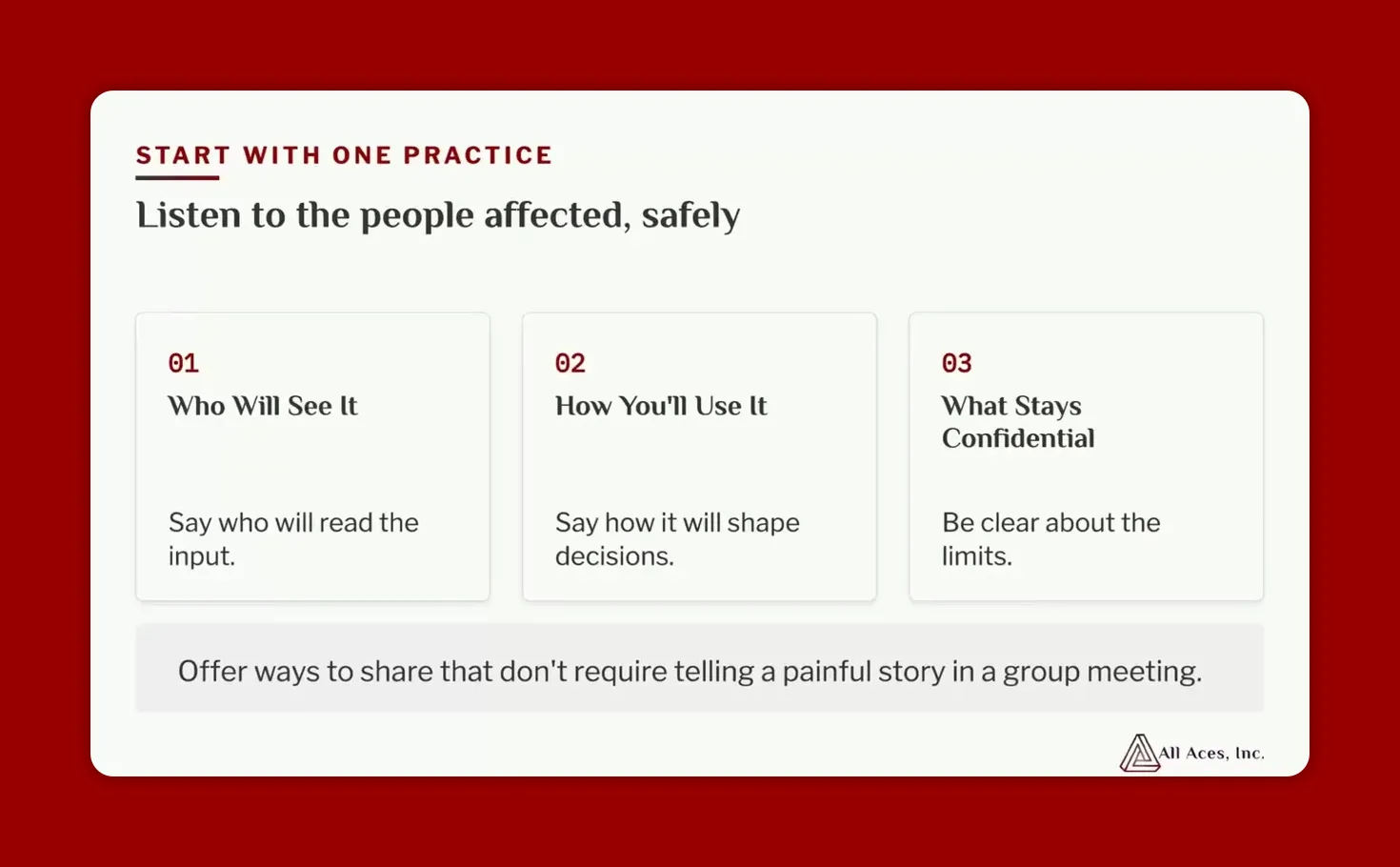
2. Listen without requiring public disclosure
Listen to the people affected, particularly those disproportionately affected. Before requesting input, explain:
Who will see what they share.
How the information will be used.
What you can and cannot keep confidential.
Provide ways to contribute that do not require people to recount painful experiences in a group session. A request for input should not create another burden or imply a confidentiality promise you cannot keep.
3. Choose one issue and connect it to authority
Select a barrier your organization can act on. Identify the person who has authority to change the relevant practice. Give the work paid time and appropriate support.
For a small team, choosing one issue is a way to focus limited capacity. It is not permission to make one change and declare the organization finished. The commitment remains broader than the first project.
Be explicit about what will change and who can authorize it. Otherwise, the person coordinating the effort can end up responsible for an outcome they have no power to deliver.
4. Set the review date before planning ends
Put the review on the calendar before everyone leaves the planning conversation. Do not make the person who raised the concern responsible for repeatedly asking what happened.
Without a clear follow-up point, employees are left deciding whether to keep chasing an answer or stop asking. Neither outcome demonstrates that the organization took responsibility.
5. Review the barrier, not just the activity
Training attendance tells you who attended training. It does not tell you whether anyone's access improved.
At the review, examine the decisions made under the revised practice. Return to the people who encountered the barrier. Where possible, hear from affected people inside and outside the organization.
Ask whether the obstacle was addressed, whether its impact was reduced, and whether people can now access what was previously difficult to navigate.
If the problem remains, adjust the approach and try again through the same collaborative process. The purpose of review is learning and improvement, not defending the first solution.
Build for the Long Term, With Hope and Intentional Action
The people doing meaningful work understand something that gets lost in the argument over whether DEI is alive or dead: this work is enduring. It is future-focused. It requires organizations built on justice, not organizations chasing the next moment of approval.
That calls for humility, humanity, hope, and a willingness to keep learning. It also requires recognizing that skill and expertise matter. Good intentions alone are not a method.
For small businesses and small nonprofits, the starting point can be close at hand: one unclear decision process, one inaccessible opportunity, one responsibility disconnected from authority. Start there, but connect the change to the organization you are trying to become.
This will not be easy. The goal is not to find an effortless version of work that matters. It is to strengthen our individual, collective, and organizational ability to do difficult work without sacrificing the people carrying it.
The free IRF Compass Snapshot offers a starting point for identifying one practice that needs attention. Treat the results with curiosity, as a baseline for learning, not a verdict that your organization is the best or the worst.
| Find One Practice to Improve Use the free IRF Compass Snapshot to establish a starting point for meaningful organizational change. Take the Free Snapshot |
Hold on to hope. It helps us remember that all is not lost and that our choices still matter. Then connect that hope to a practice, a responsible decision-maker, and a review of what people actually experience.
We do not need another swing of the pendulum. We need to stop chasing symptoms and keep changing systems.