
Take Our Free Assessment
Take Our Free Assessment
The proprietary methodology All Aces uses to help purpose-driven organizations close the gap between stated values and operational reality.
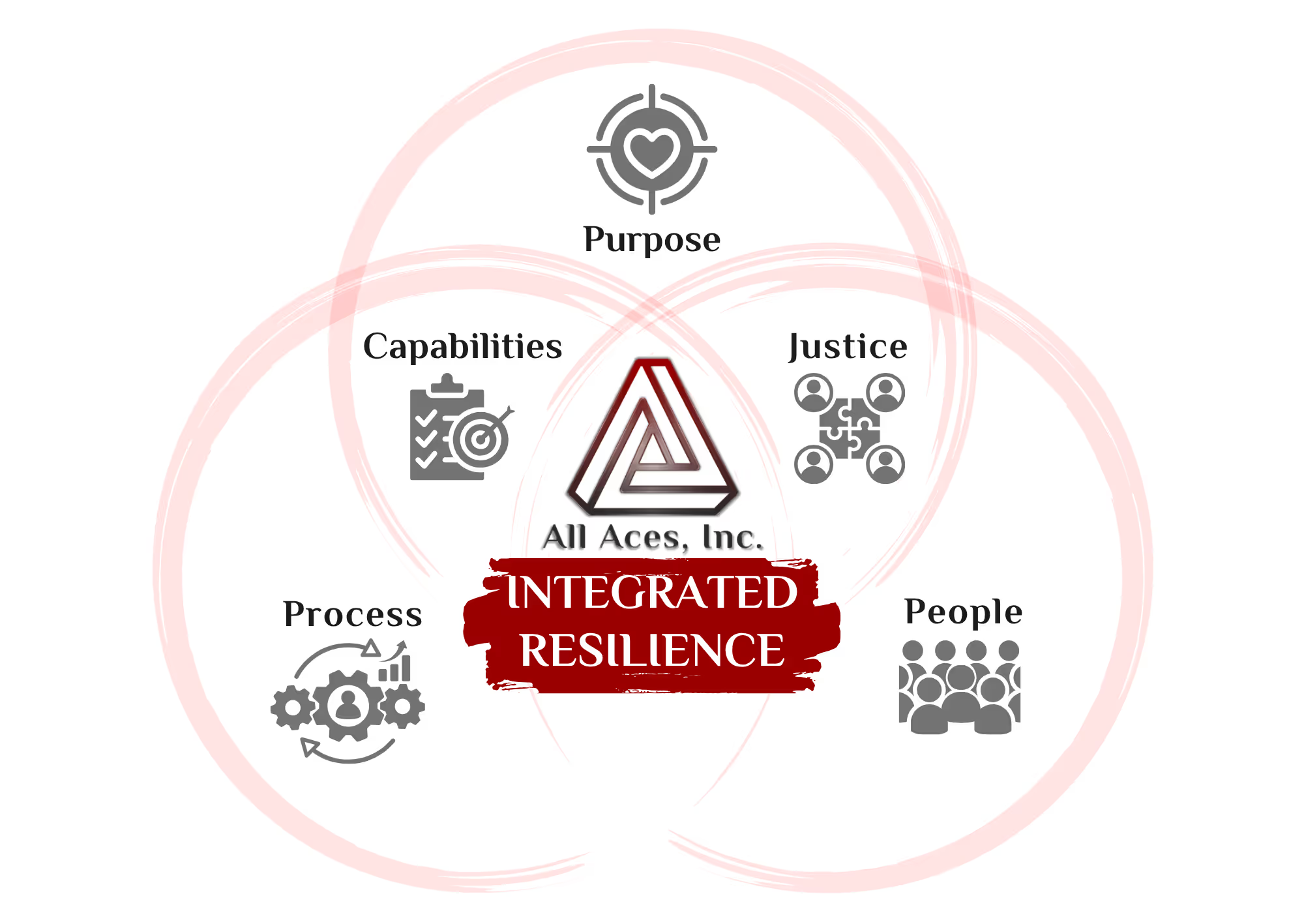
Integrated Resilience = (Purpose + People + Process) × Justice → Enabled by Capabilities
The Integrated Resilience Framework (IRF) is All Aces’ proprietary methodology for diagnosing and closing the gap between what an organization says it values and what its systems actually produce. It examines five interdependent dimensions — Purpose, People, Process, Justice, and Capabilities — to determine whether an organization is built to sustain its mission, values, and commitments under pressure.
Organizations rarely fail because they lack values. They fail because their purpose, strategy, people systems, processes, capabilities, and justice commitments pull apart under pressure. The IRF makes that drift visible and actionable.
The IRF is built on a structural proposition: resilience emerges when Purpose, People, and Process are aligned, and that alignment only holds when Justice shapes how power, resources, voice, and accountability are structured. Capabilities test whether the organization has actually built what its commitments require.
Purpose
Why do we exist, who do we serve, and what choices define our solid ground? Strategy is the first operational expression of Purpose – it turns purpose into choices, boundaries, tradeoffs, and commitments.
People
Do we have the trust, voice, roles, leadership, relationships, and repair practices needed to carry the work? Resilience weakens when people are afraid to speak, unclear about roles, or asked to compensate for weak systems through overwork.
Process
How does work actually happen across strategy processes, core operations, support functions, and innovation? Process is the operating system through which purpose becomes repeatable action.
Justice
Are benefits, burdens, voice, information, dignity, accountability, and ecosystem impacts structured fairly? Justice is the multiplier – it determines whether alignment produces shared resilience or concentrated harm.
Capabilities
Have we built the Plans, Organizational Structure, Resources, Training/Education, and Evaluation (PORTE) required to deliver? A commitment becomes operational only when the organization has built the conditions to deliver it.
Justice and Operations as One Architecture
Unlike consultants who treat DEI and operations as separate tracks, the IRF integrates equity, efficiency, and resilience into a single, coherent system – so nothing falls through the cracks.
Evidence Over
Assumptions
The “How Do We Know?” method replaces leadership guesswork with multi-perspective diagnostics and longitudinal dashboards that show real organizational capability over time.
Co-Design, Not PDF Reports
Navigator Workshops put us side-by-side with your team to map workflows, establish team agreements, and build lasting operational capabilities – because a list of problems without a path forward helps no one.
The IRF introduces the concept of the Resilience Reserve – the accumulated capacity of purpose coherence, relational trust, process integrity, capability sufficiency, and justice legitimacy that allows an organization to thrive under pressure without extracting from the people and communities around it.
Every organizational choice either builds or depletes this reserve. When an institution relies on its people’s extraordinary ability to endure stress to compensate for a dysfunctional system, it is not resilient. It is borrowing against a reserve it did not invest in. The IRF calls this pattern resilience theater – the performance of praising people for their strength in place of making the structural investments that would protect them.
The IRF Compass is the practical entry point — a staged diagnostic that moves from a free 5-minute Snapshot to a full multi-rater Benchmark with longitudinal tracking.
The IRF is documented in a 297-page white paper and the book Resilience Reimagined: Thriving in Turbulence.
Your Partner for Sustaining a Resilient Organization
Helping purpose-driven businesses, government agencies, and nonprofits build resilience through better strategy, systems, practices, and technology using the Integrated Resilience Framework (IRF)TM
Copyright © All Aces, Inc.
Contact Details
58 Winter Street
Boston, MA
+1 888 795 6569
info@allacesinc.com