
I have spent much of my life studying how racism works in people, communities, and organizations. Over the last 30 years, I have dug more deeply into its historical context and the many dynamics that keep it entrenched. The more I learn, the more clearly I see that racism is not simply complicated. It is complex.
That complexity requires us to connect ideas across fields. We need to understand habits and human development, defensiveness and self-justification, history and public policy, representation and accountability, and the structures through which organizations operate.
The books below have helped me make those connections. Some explicitly address racism and racial justice. Others explain why we do what we do and why changing those patterns is so difficult. Together, they move us beyond a conversation that ends with the individual and toward the collective, organizational, and policy work that racial equity requires.
Key Takeaways
Understanding racism requires connecting personal habits, historical context, institutional power, and organizational processes.
Self-justification can prevent us from examining harm and changing our behavior.
Meaningful representation requires ongoing relationships and accountability, not simply a shared identity.
Racial equity commitments must shape outcomes, procedures, respectful treatment, information access, and redress.
Start With Habits: Why Knowing Better Does Not Automatically Change Us
Before we talk about changing the collective habit of racism, we need to understand habits themselves. We are people. We have learned ways of interpreting the world, responding to other people, and operating within institutions. Some of those patterns are so familiar that we barely recognize them as choices.
Understanding racism, then, involves more than acquiring information. It also means examining how we have been socialized and intentionally changing how we show up.
Atomic Habits by James Clear
Atomic Habits is a useful starting point because it makes a large body of habit research accessible. James Clear brings together ideas developed across many areas of research and offers a practical explanation of what habits are, why they are difficult to change, and how we can begin shifting them.
I appreciate that accessibility. This is one of those books in my collection with flags, notes, and highlights throughout it. I do not just read books like this once and put them away. I return to them as my understanding develops.
For racial equity work, its value is foundational rather than specific. It helps us recognize that a commitment to being different does not automatically produce different behavior. We need to understand the patterns we are trying to change and the conditions that sustain them.
The Power of Habit and Smarter Faster Better by Charles Duhigg
Charles Duhigg’s The Power of Habit is another important part of this foundation, especially its discussion of the habit loop. It provides a framework for understanding recurring behavior rather than treating each action as an isolated event.
I also include his later book, Smarter Faster Better, in this group. Reading these books alongside Atomic Habits helps us appreciate the broader body of thinking behind popular conversations about habit formation and change.
That matters because racism does not persist only through decisions that people carefully deliberate. It also persists through familiar responses, assumptions, and routines. If we want to interrupt those patterns, we have to become more aware of how repetition works.
Immunity to Change by Robert Kegan and Lisa Laskow Lahey
Immunity to Change begins moving us from individual habits into organizational life. Robert Kegan and Lisa Laskow Lahey connect human mental development and our capacity to handle complexity with the challenges of change inside organizations.
This is a valuable connection for leaders. Wanting change and being prepared to engage with what change demands are not the same thing. Our ability to understand complexity influences how we interpret problems, how we respond to challenges, and what possibilities we can recognize.
Organizations bring all of those individual capacities and limitations together. They do not disappear because we have a mission statement or a leadership title.
Switch by Chip Heath and Dan Heath
The subtitle of Switch, How to Change Things When Change Is Hard, gets right to the point. Chip Heath and Dan Heath use storytelling to make the challenges of change concrete and understandable.
I appreciate books that show how people encounter difficulty and then respond intentionally. Stories help us recognize dynamics that can otherwise feel abstract. They also remind us that difficulty is not evidence that change is impossible.
These books are not substitutes for studying racism. They help us understand the human behavior that we bring into racial justice work. We need both.
Organizational Change Requires More Than Good Intentions
Here is what we often do in organizations: bring together a group of people, each with our own blind spots and challenges, and then expect us to make magic happen.
Y’all, that is a lot to ask.
We do not walk around with a mirror showing us everything about ourselves. Much of what we bring into a workplace is invisible to us. Yet it affects how we relate to others, make decisions, interpret conflict, and use power.
If an organization’s structures and processes do not acknowledge that humanity, the good, the bad, and the uncomfortable, change becomes harder to sustain.
The Heart of Change and Our Iceberg Is Melting
John Kotter’s work has helped me think about these realities. The Heart of Change, written with Dan Cohen, uses organizational stories to make change challenges and strategies more practical. Our Iceberg Is Melting, written with Holger Rathgeber, offers another accessible way to explore leadership and change.
When I directed an office of public health preparedness, our responsibilities included preparing for, responding to, and recovering from disasters across public health and health care. That work connected hospitals, community health centers, long-term care facilities, home care, and other parts of the health system.
We used the penguin story in Our Iceberg Is Melting across units in my department to deepen our understanding of leadership. It gave us a shared way to think about change rather than assuming everyone understood it in the same way.
Kotter’s Eight Steps for Leading Change
In The Heart of Change, the eight steps provide a useful organizing framework:
Increase urgency. Establish why change matters.
Build the guiding team. Bring people together to guide the effort.
Get the vision right. Clarify what the change is meant to accomplish.
Communicate for buy-in. Help people understand and engage with that vision.
Empower action. Support people in moving the work forward.
Create short-term wins. Make progress visible.
Do not let up. Sustain the effort beyond early successes.
Make change stick. Embed the change in how the organization operates.
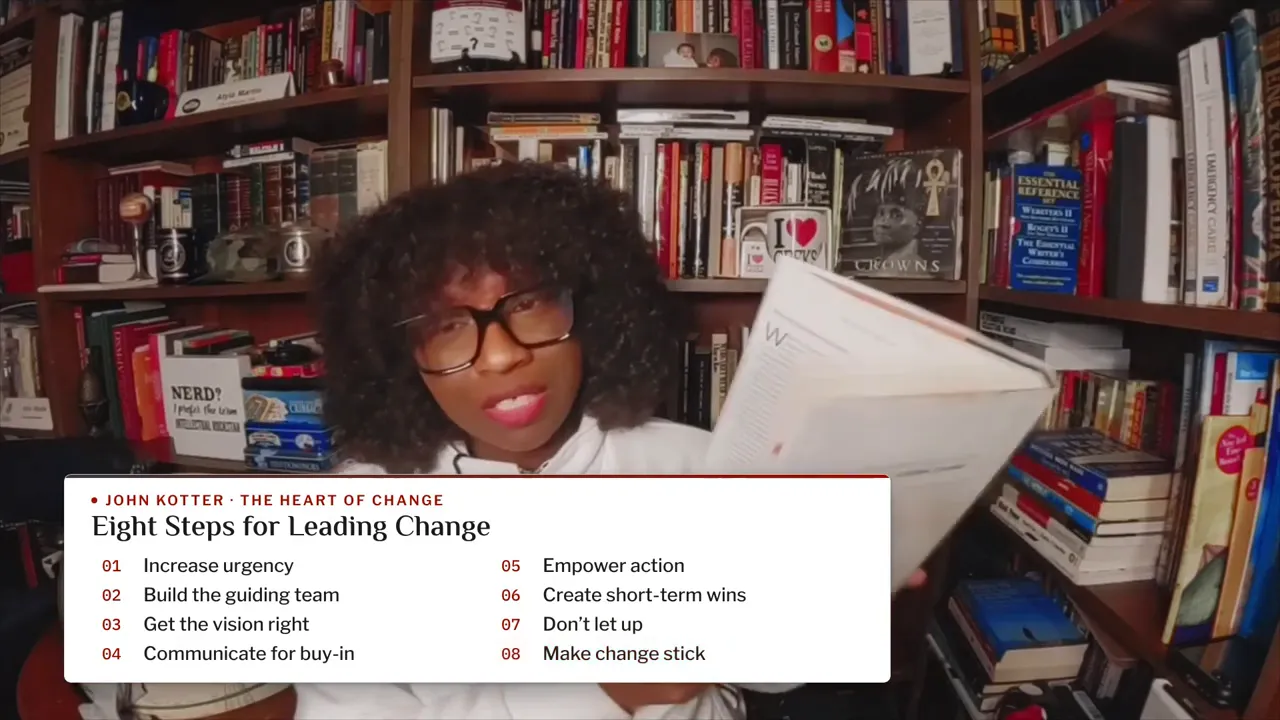
There is substantial work inside each step. A list can help organize that work, but it cannot do it for us.
At All Aces, Inc., we have integrated much of this thinking into how we help organizations address the disconnect between strategy and operations. The things we say we stand for and the ways we operate every day do not always align.
As organizations grow, people change, and complexity increases, maintaining that alignment becomes harder. Our purpose, mission, values, and everyday practices can begin moving in different directions.
A commitment to racial justice must reach the organization’s actual processes. Otherwise, the commitment can exist on paper while people continue encountering barriers to opportunity, fairness, and the ability to thrive.
Simple Habits for Complex Times by Jennifer Garvey Berger and Keith Johnston
Simple Habits for Complex Times focuses on how leaders engage with complexity. It is a useful companion to the other change books because leadership does not happen in an environment where every input or outcome is clear.
The concept of VUCA, which originated in military contexts, names four conditions:
Volatility: circumstances are continually changing.
Uncertainty: outcomes cannot always be predicted.
Complexity: many interconnected factors contribute to what happens.
Ambiguity: signals and explanations are not always clear.
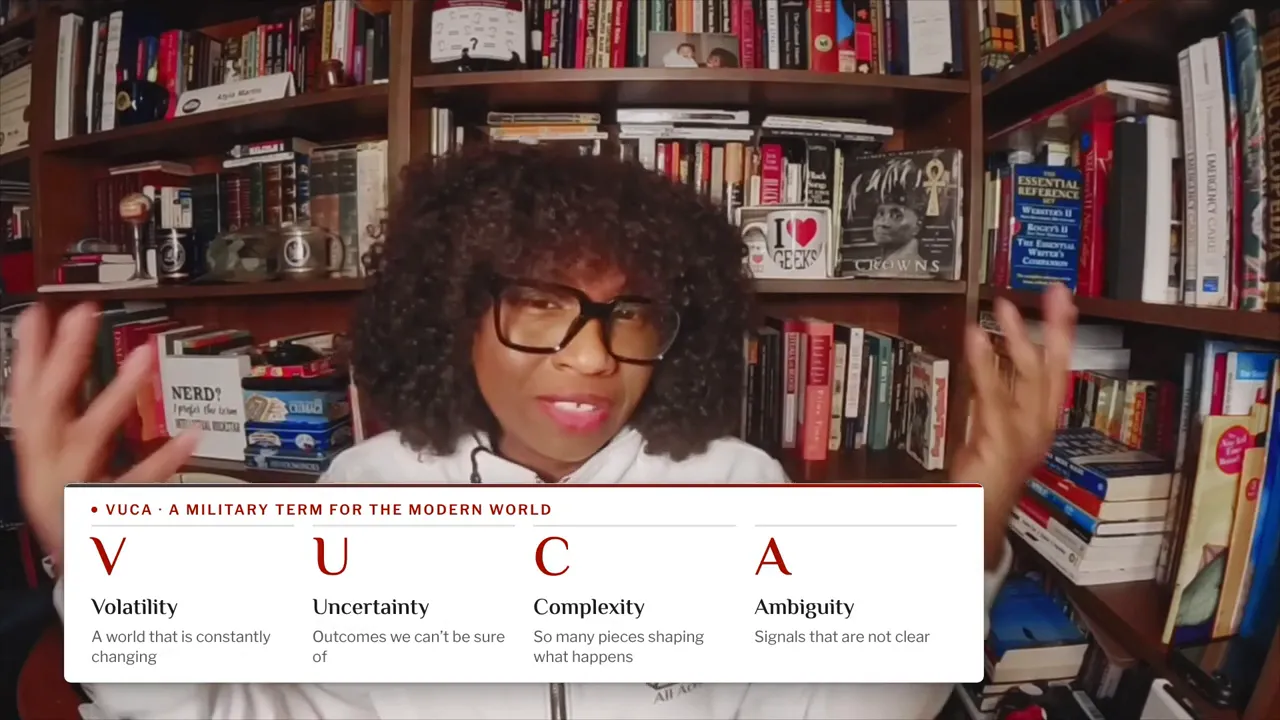
People often describe VUCA as a feature of the modern world. I am not convinced these conditions are new. We may simply have had more opportunities to ignore them.
The larger lesson from this whole group of books is that shifting how we understand and navigate the world requires effort. Changing how we interact with others, participate in organizations, and leverage leadership power is not passive work.
We sometimes fail to recognize an opportunity because it looks like hard work. Creating the communities and organizations we deserve is both: demanding work and a tremendous opportunity. Formal authority is not the only source of influence. We all participate in shaping the spaces we occupy.
When We Get Called Out: Understanding Self-Justification
It is one thing to talk about changing habits. It is another thing to have someone point out a habit of ours that caused harm.
That is where Mistakes Were Made (But Not by Me), by Carol Tavris and Elliot Aronson, becomes especially useful. Its subtitle, Why We Justify Foolish Beliefs, Bad Decisions, and Hurtful Acts, captures a dynamic that matters deeply to racial justice work.
This is one of my favorite books because it invites humility. If we are willing to reflect honestly, we can recognize ourselves in the patterns it describes. If we are not ready for that yet, we may at least recognize something we have seen others do.
Why Defending Ourselves Can Become the Priority
The book’s discussion of cognitive dissonance helps explain why causing harm can generate a powerful need to justify our behavior. After acting, we often want an explanation that makes the action feel reasonable.
That impulse can be immediate. Rather than examining what happened, we begin defending why we did it.
The authors also discuss why venting through aggression can backfire. An aggressive act does not necessarily resolve the original emotion. It can introduce another problem: the need to explain away the harm we have now caused.
For leaders, this is an important distinction. A response that protects our self-image is not necessarily a response that helps us understand our impact. When racial equity work challenges something we have done, self-justification can pull us away from learning.
The Problem With Mental Shortcuts
The book also examines categorization, prejudice, and stereotypes. Our minds use categories to process information efficiently. Those shortcuts can help us make quick judgments based on previous experience.
But efficiency has a cost.
Stereotypes flatten differences within a group and exaggerate differences between groups. We lose sight of individual variation while making group boundaries seem more definitive than they are.
That is worth sitting with. A shortcut that feels useful can still distort our understanding of another person. Recognizing that tendency does not excuse prejudice. It gives us something specific to examine.
I return to this book because learning is not a one-time event. As I grow, I notice different things. A book that challenged me years ago can challenge me again in a new way.
History: We Know Less Than We Think We Do
One of the most important lessons in this work is how much history we have not learned. Having a degree does not mean we have encountered every important history or understood every connection. I say that as someone with a doctorate. No shade, y’all.
Schooling can provide a foundation without providing the full picture. Continuing to learn outside formal education matters because historical context changes how we understand present-day conditions.
Before 1619: A Longer History of African Presence
One discovery that challenged my own understanding was the history of Africans in what is now the United States before 1619.
The familiar 1619 milestone concerns the arrival of enslaved Africans in the English colony of Virginia. It is not the beginning of African presence on the land that later became the United States.
The NextHistory Project’s work on 1526 examines an earlier Spanish colonial effort associated with Lucas Vázquez de Ayllón. The account describes an attempted settlement in the region of present-day South Carolina and Georgia, with uncertainty surrounding its precise location.
The expedition brought at least 100 enslaved Africans. As the colony collapsed, enslaved Africans escaped. Some researchers connect their subsequent lives with the Guale people in the region, while much about what happened afterward remains uncertain.
That history extends the timeline nearly a century before 1619. It also puts two anniversaries in perspective: 2026 marks 250 years since American independence and 500 years since the 1526 episode.
The point is not to replace one oversimplified starting point with another. It is to recognize that our familiar historical markers do not contain the whole story.
When Affirmative Action Was White by Ira Katznelson
When Affirmative Action Was White: An Untold History of Racial Inequality in Twentieth-Century America offers a policy-centered account of how the country arrived at racial inequalities that remain visible today.
I value this book because it connects historical policy decisions with conditions in Black communities and other communities of color. It helps move the conversation beyond explanations that focus only on individuals.
I also believe we can respect important scholarship while questioning proposed responses to inequality. In a panel conversation with Ira Katznelson, I had concerns about an approach centered on moving Black and poor people into communities characterized as offering greater opportunity.
My concern is broader than relocation itself. Data and models can provide useful proxies for reality, but they do not represent all of reality. Context matters. Moving people to wealthier communities cannot, by itself, answer the many dimensions of racial inequality.
There is no single answer. That does not diminish the book’s historical value. It reminds us to distinguish between understanding a problem and evaluating a proposed response.
White Rage by Carol Anderson
Dr. Carol Anderson’s White Rage examines related history through the relationship between Black progress and white backlash, a dynamic Martin Luther King Jr. also named.
This perspective helps us understand that progress is not necessarily followed by more progress. It can be followed by efforts to restrict or reverse it.
Backlash can also be engineered. Framing issues around particular groups can encourage people to support positions that do not serve their own interests. Understanding that pattern helps connect historical developments with the ways power operates.
Together, these books encourage us to ask not only what happened, but how policies, political responses, and public narratives shaped what became possible.
Identity, Learning, and the Humility to Change Our Minds
History is not only a story about institutions. It also shapes how we understand ourselves.
Gil Noble’s Black Is the Color of My TV Tube, published in 1981, offers a powerful account of a Black television journalist developing a deeper understanding of his identity, career, and social context.
Noble describes growing up with more access to resources than some other Black people. That background meant there were experiences and circumstances he did not fully understand. Professional success did not automatically give him that understanding.
His changing perspective on Malcolm X is particularly meaningful. Noble initially held a deeply negative view of Malcolm X. As he learned more about the person and the substance of his ideas, that understanding changed.
What stayed with me was how practical that learning became. Noble connected Malcolm X’s example with punctuality, responsibility, disciplined reading, and becoming more effective in his work.
Reading acquired a purpose. Studying people in history who had encountered similar problems helped him think through his own.
Most importantly, he described knowledge as reducing ego and increasing humility. Learning more made the limits of his knowledge more apparent, not less.
That is the kind of perpetual learning this work requires. Knowledge should help us become more thoughtful and effective, not simply more certain that we are right.
Representation Is Not the Same as Accountability
Black Power: The Politics of Liberation, by Kwame Ture, formerly Stokely Carmichael, and Charles V. Hamilton, brings us back to the opening question: what is racism?
The book challenges an overly narrow focus on individual racism and examines institutional racism. Individuals matter because we make decisions and participate in institutions. But institutional policies and practices cannot be understood only by looking for overtly racist behavior.
The authors describe how institutional arrangements sustain exploitation and exclusion, including in housing. They also examine the relationship between institutional power and individual attitudes.
That intersection matters: who we are as people influences how we operate organizations, and organizations give those choices structure, repetition, and reach.
A Shared Identity Does Not Guarantee Shared Interests
Another reason I return to Black Power is its challenge to the assumption that people automatically represent the interests of everyone who shares their identity.
This assumption troubled me before the racial justice conversations surrounding George Floyd, and it became even more pronounced during that period.
Being Black does not automatically mean I understand the experiences, priorities, or circumstances of every Black community. The same principle applies to any group.
A seat at the table is not enough. Meaningful representation requires:
Relationships with the people being represented.
Understanding of their circumstances and priorities.
Continued listening and engagement.
Accountability to those people, not only to the institution offering access.
Without those connections, a representative becomes more vulnerable to the pressures of power. Access, recognition, and opportunities can begin redirecting whose interests that person serves.
Do Not Become a Cut Flower
Reverend Calvin O. Butts III used the image of a cut flower to describe the danger of disconnecting from one’s base after achieving success. A flower may remain attractive for a while after being cut, but it cannot sustain itself without its roots.
That image applies to representation. We need relationships beyond the powerful table where we have been invited to sit. We need other spaces where people can question us, inform us, and hold us accountable.
Do not become a cut flower on the table of white supremacy, y’all. Access without connection is not the same thing as power in service of a community.
The principle applies inside organizations, too. If you represent a team, you must remain connected to the barriers its members encounter. Leadership requires more than speaking on their behalf. It requires being answerable to their experience.
Black Bourgeoisie by E. Franklin Frazier
Black Bourgeoisie adds another layer by examining class interests within Black America. E. Franklin Frazier challenged myths about Black success and questioned whose needs were being advanced by influential Black elites.
His research challenged the idea that the aspirations of upper- and middle-class Black people necessarily reflected the interests of working-class and poor Black people.
The lesson is not that identity does not matter. It is that identity alone cannot tell us whose interests an agenda serves.
What are we advocating for? Who do we have in mind? Are we accountable to anyone beyond our own needs? Those questions belong in every conversation about representation.
Make Fairness Concrete Through Organizational Justice
Dr. Susan Gooden’s Race and Social Equity: A Nervous Area of Government helps connect racial equity with institutional practice. Although the book focuses on government, its relevance extends to businesses and nonprofits.
Gooden explains that fairness must be examined at three levels: the outcome, the procedure that produced and implemented it, and the system in which both are embedded.
This connects with several dimensions of organizational justice:
Distributive justice: fairness in outcomes.
Procedural justice: fairness in the processes that generate outcomes.
Interpersonal justice: respect for people’s dignity and humanity.
Informational justice: access to sufficient, high-quality information in time to participate meaningfully.
Interpersonal and informational justice are commonly grouped under interactional justice. Together, these dimensions make fairness more concrete than a general promise to treat people well.
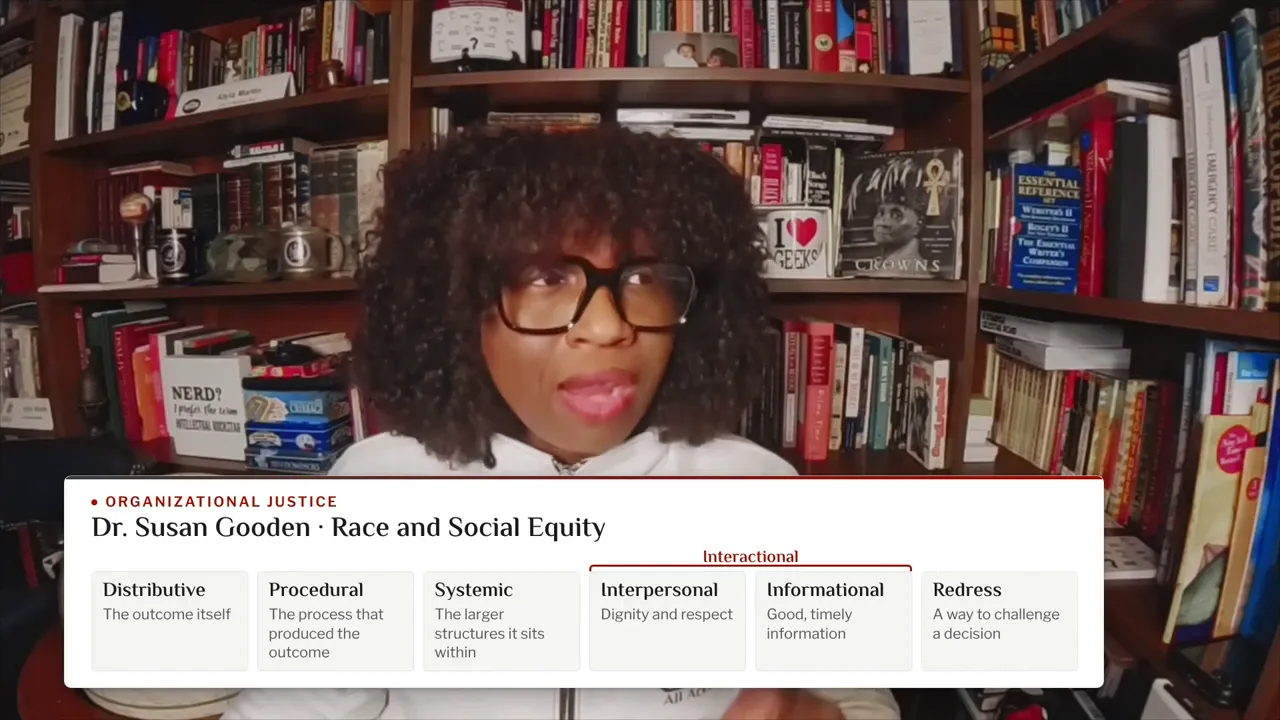
A process also needs redress. People must have a structured way to challenge a decision without retaliation for using that process.
Notice how much this asks us to examine. Was the outcome fair? Was the procedure fair? Were people treated with respect? Did they have information early enough to make a good decision? Could they challenge what happened?
Those are organizational questions, not just questions about whether a particular person had good intentions.
Connect Personal Learning With Structural Change
My book, We Are the Question + the Answer: Break the Collective Habit of Racism and Build Resilience for Racial Equity in Ourselves and Our Organizations, brings many of these threads together.
Yes, that subtitle is long, y’all. It reflects the connections I wanted to make.
The book synthesizes research and documented experience to explore who we are, why we do what we do, and how we can move closer to the people we want to be. It focuses primarily on ourselves and how we show up in institutions, while beginning to explore organizational possibilities.
Resilience Reimagined develops the organizational focus further and lays the foundation for the Integrated Resilience Framework. This work brings together justice, psychology, sociology, organizational resilience, and other fields to connect people, strategy, processes, and institutional life.
Look for the Process Behind the Inequity
Across our work with more than 200 clients, we have repeatedly found that organizational inequities can often be traced to specific policies and procedures within identifiable processes.
Promotion is a concrete example. Leadership may believe the promotional process operates one way, while employees experience something very different as they try to navigate it.
Understanding that gap requires asking who is having different experiences and why. It also requires examining the actual process, not only leadership’s description of it.
The experiences of Black, Indigenous, and other people of color can make organizational dysfunction especially visible because they are disproportionately affected. Yet the same dysfunction may also harm white colleagues.
That does not erase racial inequity. It helps identify the structures and processes that need attention. Instead of treating the people encountering barriers as the problem, we can examine the arrangements producing those barriers.
That shift opens a different set of opportunities for action.
The purpose of this reading is not to accumulate titles or become the person with the most impressive bookshelf. It is to become more capable of connecting what we learn with how we act.
We need humility, historical context, accountable relationships, and structures that support justice. We need to align our stated values with everyday operations. And we need to keep learning while doing the work.
I am sending love, hope, and intentional action for that journey. The work is demanding, but our ability to change the spaces we inhabit is real.
| Put Integrated Resilience Into Practice Explore the Integrated Resilience Framework and connect with the IRF practitioners community. Explore the IRF Hub |
Frequently Asked Questions
Why include habit and leadership books in a reading list about racism?
They explain how behavior forms, why change is difficult, and what organizations need to sustain change. That foundation complements books explicitly addressing racial history, institutional racism, and equity.
What is the difference between individual and institutional racism?
Individual racism concerns people’s attitudes and actions. Institutional racism operates through organizational policies, practices, and processes. The two connect because people make decisions within institutions, but focusing only on individuals leaves institutional arrangements unexamined.
Does sharing a community’s identity make someone an effective representative?
Not automatically. Effective representation requires relationships, knowledge of people’s circumstances, continued listening, and accountability. Shared identity does not guarantee shared priorities or interests.
Where can leaders begin examining racial inequity in an organization?
Begin with a concrete process, such as promotion. Compare leadership’s understanding with employees’ experiences, identify who encounters barriers, and examine outcomes, procedures, dignity, information access, and opportunities to challenge decisions without retaliation.